PainChek targets US breakout moment with 4DMedical chair appointment

PainChek’s push into the United States has received a significant endorsement with the appointment of 4DMedical chair Lil Bianchi, as the ASX-listed digital health company positions itself as an emerging US healthcare software growth story.

Lil Bianchi
The appointment comes at a pivotal point for PainChek, which recently secured FDA De Novo clearance for its AI-powered pain assessment technology and is now accelerating commercial expansion across North America.
For investors, the parallels with 4DMedical are difficult to ignore.
Bianchi oversaw a period of explosive growth at 4DMedical as the respiratory imaging company transformed from a relatively small ASX healthcare stock into a business now valued at more than $2 billion, driven largely by its US expansion strategy. Less than a year ago, 4DMedical was valued closer to $130 million.
PainChek is now attempting to execute a similarly ambitious playbook.
Like 4DMedical, PainChek operates a software-as-a-service healthcare model targeting large-scale adoption in the US market through regulatory approvals, enterprise integrations and reimbursement pathways.

Its technology uses facial recognition AI and observational indicators to assess pain in people unable to reliably self-report, particularly those living with dementia. Delivered through a smartphone or tablet application, the platform is already being used across aged care facilities in Australia, New Zealand, the UK and North America.
PainChek says it has now conducted more than 20 million digital pain assessments globally across more than 2,000 aged care facilities, building what management describes as one of the world’s richest pain assessment datasets.
But the real opportunity lies in the United States.
In a recent investor presentation, chief executive Philip Daffas described North America as the company’s key growth driver and the market expected to take PainChek to profitability.
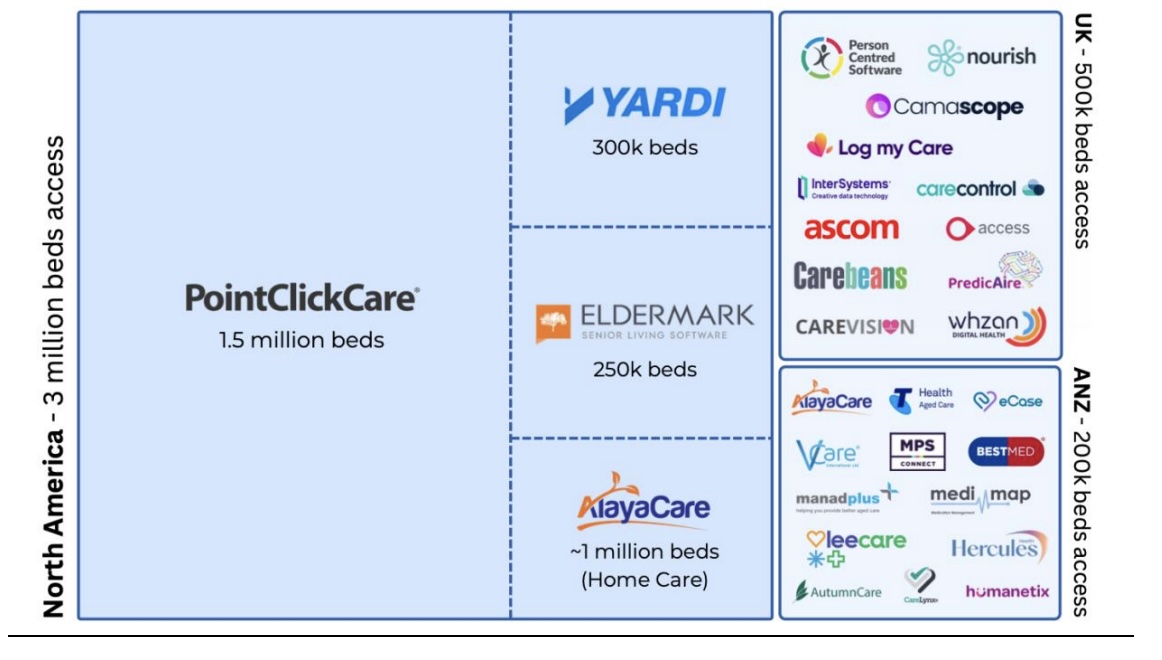
Central to that strategy is PainChek’s integration with PointClickCare, the dominant clinical software platform in the US long-term care sector, which services approximately 1.5 million aged care beds.
The company has already achieved around 35 per cent penetration of the Australian residential aged care market, representing about 70,000 licences.
If PainChek were able to achieve similar penetration across PointClickCare’s US network alone, it would equate to roughly 450,000 beds - before considering the remaining 1.5 million aged care beds across the broader US market.
Importantly, PainChek enters this next phase with established operations already demonstrating commercial traction.
Its Australian business has reached operational break-even, while the UK business has now surpassed 50,000 beds - more than 10 per cent market penetration - and is approaching short-term operational profitability. The UK operation also grew licensed beds by approximately 9 per cent during the March quarter.
That materially changes the investment proposition.
Rather than funding an unproven concept, investors are increasingly looking at a business with validated commercial models in Australia and the UK attempting to scale into the world’s largest aged care market.
Management believes the company is now moving beyond groundwork and into scaled commercial execution.
Last week PainChek secured $5.5 million in convertible note financing to support US sales expansion and working capital, with the company saying the funding would maintain momentum in North America following its “landmark” Sabra agreement.
Sabra Health Care REIT has exposure to more than 20,000 aged care beds across the US market. Under the arrangement, individual facilities can adopt PainChek through a streamlined opt-in process with head office approval, creating what investors hope could become a scalable rollout model across the network.
Management also believes the Sabra agreement could become a blueprint for similar partnerships with other major healthcare REITs and aged care operators across North America.
PainChek has also signed Jewish Home Family, a respected US aged care provider led by Carol Silver Elliott, the former chair of LeadingAge and Jewish Senior Life.
Within the ageing services sector, Elliott is viewed as a highly influential figure, with her support potentially opening broader industry relationships and referral pathways across the US market.
Taken together, PainChek’s North American strategy appears to be forming around three pillars: enterprise software integration through PointClickCare, direct operator penetration via groups such as Sabra and Jewish Home Family, and reimbursement.
Daffas recently told investors the company was pursuing multiple reimbursement pathways tied to its FDA-cleared status, including Remote Therapeutic Monitoring opportunities that could potentially unlock reimbursement claims of up to US$150 per resident per month.
PainChek is also pursuing broader home care opportunities in the US market, which management says could ultimately become significantly larger than the institutional aged care sector.
Bianchi’s appointment signals the board increasingly sees PainChek not simply as an Australian and UK aged care technology company, but as a global healthcare software platform entering its next phase of commercialisation.
“I am absolutely delighted to be appointed Chair of PainChek at this exciting moment in the Company’s journey,” Bianchi said following her appointment. “PainChek is well positioned as the world’s first FDA-cleared medical device for pain assessment.”
Whether PainChek ultimately follows a trajectory similar to 4DMedical may depend on how quickly those US partnerships convert into contracted beds, recurring revenue and scaled adoption across the world’s largest healthcare market.