PainChek’s next act is all about commercial proof

PainChek (ASX) has already answered one of the harder questions confronting an emerging med-tech company: does the product work, and will customers actually use it?
With 90,198 implemented licences across 1,990 active sites and more than 21.3 million assessments completed by June 30, there is substantial evidence that PainChek's AI-enabled pain assessment platform has moved well beyond technological validation.
The question for investors is now a more interesting one: how large can the commercial opportunity become, and how valuable can PainChek become to the healthcare providers adopting it?
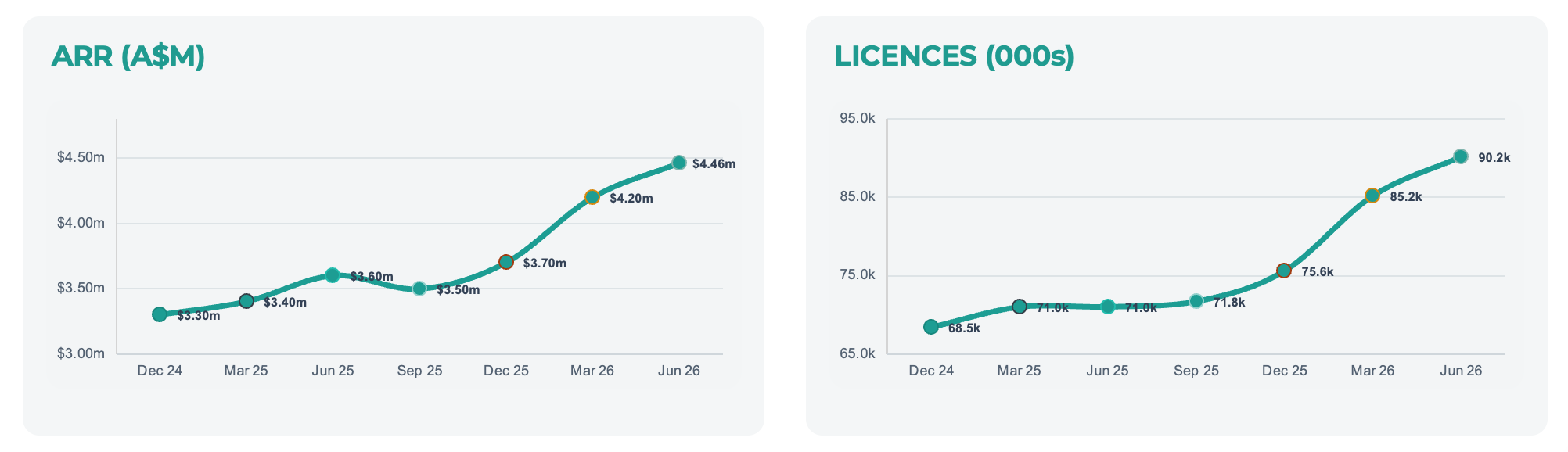
PainChek ended FY26 with implemented annual recurring revenue of $4.46 million, up 5.9% in the June quarter, while customer receipts rose 27% quarter-on-quarter to $1.284 million. Customer revenue for FY26 increased about 12% to $3.75 million.
That gives the company something many emerging healthcare technology businesses spend years trying to build - a meaningful installed base, recurring revenue and a product already embedded across a sizeable number of care facilities.
The scale of usage is also worth dwelling on. More than 21 million pain assessments means PainChek is not simply software sitting on a licence register. It is being used repeatedly at the point of care, where clinicians and carers are making decisions about residents whose pain can otherwise be difficult to identify and manage.
That matters because the pressures facing aged-care and long-term-care providers are becoming more acute. Residents are increasingly living longer with complex co-morbidities, including dementia and other cognitive conditions that can limit their ability to reliably communicate pain. At the same time, clinical teams are stretched, staffing remains tight and operators are under pressure to manage rising costs and constrained operating margins.
For providers, poorly identified or poorly managed pain can have consequences beyond discomfort. It can contribute to distress, behavioural changes and reduced mobility, while falls, medication use and potentially avoidable hospital transfers all carry clinical and financial costs.

PainChek's proposition is that technology should augment the care team rather than add another administrative burden. By digitising pain assessment at the point of care and integrating into clinical workflows, the platform is designed to help staff identify pain more consistently, act earlier and document the result.
There is also evidence suggesting that this can translate into measurable operational and clinical outcomes. An independent KPMG evaluation of PainChek's Australian residential aged-care rollout found 85% of surveyed respondents reported benefits from using the system, including improved pain identification, increased workforce confidence and improved resident health outcomes. The evaluation also found that sharing PainChek results prompted changes in treatment pathways, including medication prescription.
UK case studies provide another indication of the potential value proposition. Orchard Care Homes, which implemented PainChek across 24 homes and 1,365 beds, reported a 48% reduction in PRN medications and estimated savings of six to 10 staff hours per home per month. Its experience also included reductions in distressed behaviours, antipsychotic use and safeguarding incidents.
Separately, Scottish care-home experience reported a 75% reduction in falls over three months and a 42% reduction over six months, alongside more appropriate medication use. These individual studies should not be treated as a universal return-on-investment calculation, but they provide useful context for investors trying to understand why the installed base and assessment numbers matter commercially.
The next phase is about scaling that foundation, particularly in the US and UK, while continuing to demonstrate that PainChek can help providers address clinical problems that also carry meaningful operational costs.
Implementation is where the value starts to show
One of the more useful changes in PainChek's recent reporting is its greater emphasis on implemented licences and implemented ARR.
A signed contract shows demand. An implemented licence shows that the customer has progressed to actual use and that revenue is beginning to flow.
Chair Lil Bianchi made that priority clear during PainChek's August investor webinar.
"As well as winning sales, we have to be much faster at implementation, getting the revenue flowing," she said, adding that management wanted to be "utterly focused on our short-term execution on the pipeline, no distractions".
For investors, that creates a relatively straightforward way to judge progress.
The June quarter provided some useful evidence. Implemented licences increased by 4,998, customer sites grew to 1,990 and cumulative assessments climbed 13.7% to 21.38 million.
Those numbers suggest PainChek is not simply adding customers, but deepening real-world usage across its platform. That distinction matters. A growing installed base demonstrates distribution, while a rising assessment count demonstrates engagement. Together, they provide a stronger indication that the technology is becoming part of routine clinical practice.
America is the biggest growth lever
The US remains the most important potential driver of a step-change in PainChek's commercial profile.
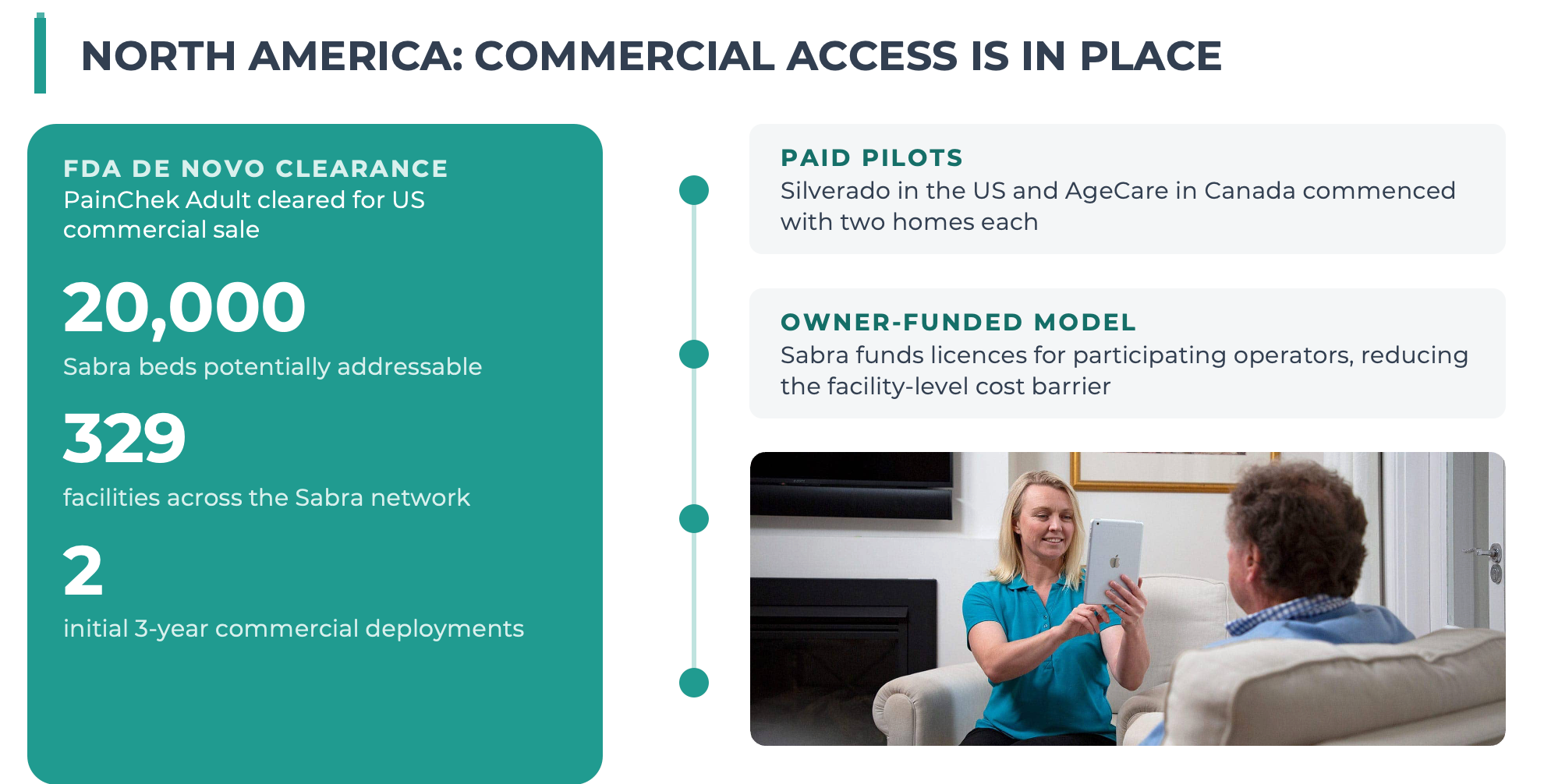
FDA De Novo clearance established the regulatory platform, while the Sabra Health Care REIT relationship has created a pathway to potential deployment across as many as 20,000 beds.
PainChek secured its first two three-year commercial contracts under Sabra in June, covering Traditions memory-care facilities.
The dollar contribution from those first facilities is less important than what they could represent.
If initial deployments lead to adoption across additional Sabra operators and facilities, PainChek begins to demonstrate a potentially repeatable route into the fragmented US long-term-care market.
Incoming CEO Karen Holzberger highlighted this point during the August webinar, referring to the importance of proving the Sabra relationship and converting late-stage opportunities into commercial customers and reference sites.
That referenceability could become increasingly important.
Healthcare providers are understandably cautious about introducing new clinical technologies, particularly when budgets and staff time are already under pressure. Evidence that a system can improve clinical workflows, save staff time or contribute to outcomes such as better medication management and fewer falls can therefore be as important commercially as the technology itself. Evidence from comparable facilities can shorten that decision-making process, particularly when the product is integrated into existing clinical systems and workflows.
North American business development head David Allsopp also highlighted integrations as a key part of the commercial strategy, with PainChek working alongside electronic health record platforms used across the US long-term-care sector.
The attraction for investors is that each successful deployment can potentially make the next one easier. If PainChek can establish reference customers that demonstrate both clinical value and an economic benefit to operators, the US proposition becomes considerably more compelling.
The UK is already providing international evidence
While the US offers the largest potential upside, PainChek's UK business is providing more immediate evidence that the platform can scale beyond Australia.
UK implemented licences increased 11.3% during the June quarter to 33,470, while ARR rose 10% to $1.85 million.
Australia and New Zealand remain the commercial foundation, with 55,246 implemented licences, but the increasing contribution from the UK is significant.
It demonstrates that PainChek's business model is not confined to its home market.
That matters because the investment case ultimately depends on international replicability.
If PainChek can repeat elements of its Australian and UK experience in the US, the company's existing recurring-revenue base could look increasingly like the foundation of a much larger business rather than simply a mature domestic franchise.
The UK experience is also significant because PainChek has accumulated some of its clearest customer outcome data there. That gives the company more than a sales case when approaching new providers - it can point to existing implementations where operators have reported changes in medication use, staff time, falls and resident behaviours.
More growth can also come from existing customers
Another potentially underappreciated opportunity is expansion within PainChek's current customer base.
Interim CEO and COO Andy Hoggan pointed during the webinar to Catholic Healthcare, where PainChek has expanded beyond residential aged care into home care.
For a software-style recurring-revenue model, that is an attractive form of growth.
Winning a new customer is one route to higher ARR. Selling more licences, entering additional facilities or extending into new care settings within an established customer can be another.
That makes retention and expansion increasingly important measures of revenue quality.
PainChek reported customer retention of around 85% at June 30. Improving that figure while expanding usage among existing customers would strengthen the recurring-revenue characteristics of the business and potentially improve the economics of future growth.
The growing number of system integrations is relevant here as well. PainChek has developed dozens of integration partnerships with clinical systems, which can reduce friction for staff and make the platform more deeply embedded within a provider's existing technology environment. In a sector where care teams are already stretched, ease of use and workflow integration can be an important competitive advantage.
A CEO aligned with the commercial opportunity
The appointment of US-based Karen Holzberger as CEO also looks well matched to the stage PainChek has reached.
Holzberger has more than two decades of healthcare leadership experience, including senior roles at Nuance Healthcare and GE Healthcare.
During the webinar, she described her background as including "referenceability and commercialisation at scale".
Those words are particularly relevant for PainChek.
The technology has already achieved regulatory and clinical validation. The next task is less about proving the underlying concept and more about turning that credibility into faster implementation, broader adoption and increasing recurring revenue.
Holzberger also pointed to retention, closing key commercial opportunities and converting them into revenue as important measures of successful execution.
What investors should watch next
PainChek is entering a stage where the investment case is becoming increasingly measurable.
Implemented ARR is the first metric to watch because it provides a direct indication of commercial activity becoming recurring revenue.
US deployments are the second. The important development will not simply be another customer announcement, but evidence that initial customers are leading to more facilities, more licences and broader adoption.
Retention and customer expansion are also important. Improvements here would strengthen the quality of PainChek's existing revenue base while reducing reliance on new customer acquisition alone. Just as importantly, investors should watch for further hard evidence of the value PainChek creates for providers - particularly around staff efficiency, medication use, falls, hospital transfers and other measures with a direct clinical or economic impact.
Customer receipts and commercial conversion will provide another useful measure of whether increasing scale is flowing through to the financial performance of the business.
Bianchi summed up the next stage neatly during the webinar with the words "execution and proof points".
That is also a useful way for investors to approach PainChek.
The company has built a substantial base of clinical use, recurring revenue and customer adoption. Importantly, there is also growing evidence explaining why providers are adopting the platform - because accurately identifying pain can improve care while potentially helping operators tackle issues such as medication use, falls, staff workload and the broader cost of managing increasingly complex residents.
PainChek now has regulatory access to the world's largest healthcare market, growing momentum in the UK and a US-based CEO with a commercialisation background.
The opportunity from here is to turn those foundations into faster recurring-revenue growth and demonstrate that international adoption can be repeated at scale.
Further evidence that clinical adoption is translating into measurable value for providers could also strengthen the commercial case considerably, particularly in the US where healthcare operators are intensely focused on both care outcomes and economics.
The technology story is already well established.
The more interesting story now is how much commercial value PainChek can build from a platform that is already being used at scale.
Disclaimer: This article is for general information only and does not constitute financial or investment advice. It has been prepared using publicly available information and company commentary. Investors should conduct their own research and consider their individual circumstances before making any investment decision.