The Morning After: Why Memphasys’ CE Mark Approval Feels Different - and What Comes Next

A day on from Memphasys confirming CE Mark approval for its Felix™ System, the initial headlines are giving way to something more important: perspective.
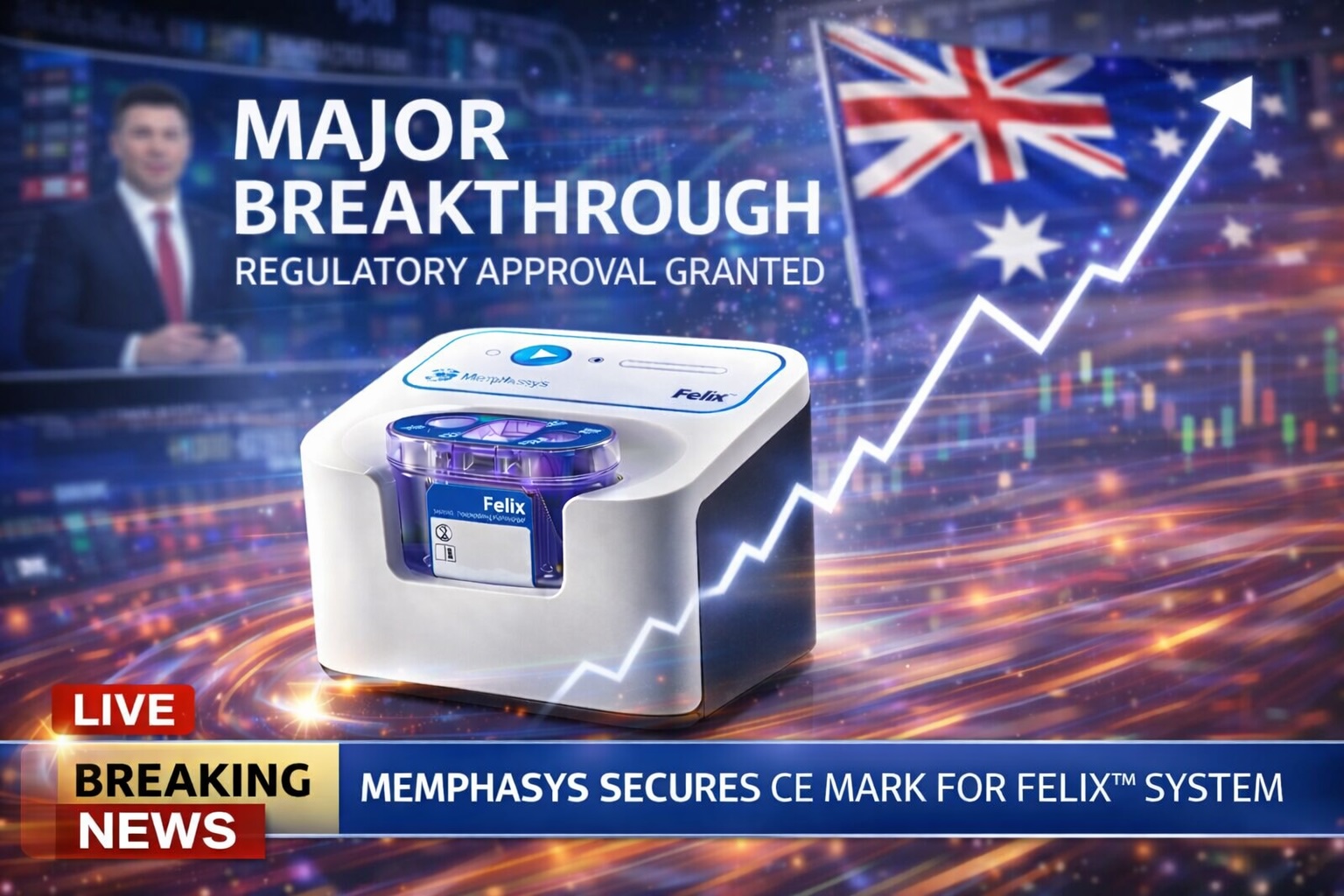
Yesterday’s announcement was rightly framed as a regulatory breakthrough. But with the benefit of distance and context, it is becoming clear that this milestone does more than unlock a market. It reshapes the company’s trajectory, its risk profile, and the way investors should think about what comes next.
For long-standing shareholders, this matters.
From “Someday” to “Now”: Closing a Long Regulatory Chapter
For much of the past six years, the idea of Felix™ achieving regulatory approval in an established market such as Europe oscillated between ambition and frustration. There were moments when the path seemed clear, and others when shifting regulations, particularly the introduction of Europe’s Medical Device Regulation (MDR), made the goal feel like a mirage.
CE Mark approval brings that chapter to a close.
Under MDR, approval is no longer a procedural hurdle. It is a structural validation of a device’s clinical evidence, manufacturing systems, quality controls and long-term compliance framework. Many devices never made the transition. Felix™ has.
With that approval now secured, Felix™ moves from being a technology seeking permission to operate, to one authorised to scale.
Why the Timing Matters More Than the Approval Itself
In isolation, regulatory approval is important. In context, it is transformative.
What distinguishes this moment from earlier phases in the Felix™ story is that CE Mark approval has arrived after the company completed the hard work of commercial preparation.
Multi-year, volume-backed commercial agreements were already signed, including binding minimum purchase commitments. Clinics were trained and operationally prepared. Manufacturing had scaled to support early commercial demand, with cost-of-goods materially reduced. Early cartridge orders were already flowing.
This sequencing changes the investor equation.
Instead of approval triggering a new round of planning, it immediately activates revenue pathways. For investors, this shifts Felix™ from a regulatory-dependent asset to a commercially executing platform.
What This Means for the Next 6-12 Months
From an investor perspective, the focus now shifts decisively from whether Felix™ can be commercialised to how quickly it scales.
Over the coming quarters, investors should be watching for:
Recurring revenue visibility as contracted cartridge purchases under binding agreements begin to flow through
Clinic utilisation data, particularly early adoption patterns in Europe and the Middle East and North Africa
Margin progression, driven by improved manufacturing efficiency and higher cartridge volumes
Sales cadence, rather than one-off announcements
Importantly, revenue growth from Felix™ is not expected to be linear. Adoption in IVF clinics typically follows a curve - initial onboarding, workflow integration, then expanding utilisation once confidence and familiarity are established.
CE Mark approval removes the gating factor that previously prevented this curve from starting.
The Strategic Optionality Now in Play
Beyond near-term revenue, CE Mark approval introduces strategic optionality that simply did not exist before.
It enables immediate commercial activity not only across Europe, but also in CE-recognising Middle East and North Africa jurisdictions, including markets such as Qatar where Felix™ can now be sold immediately.
It also provides a recognised regulatory foundation for progression in India and Australia, both of which represent large, strategically important IVF markets. Regulatory timelines in these jurisdictions are now materially shortened due to mutual recognition pathways.
Finally, regulatory de-risking increases Felix™’s attractiveness as a platform asset. Once a device is approved under MDR and generating contracted revenue, it becomes easier to expand distributor discussions, negotiate broader regional partnerships and attract strategic interest from larger IVF or medtech groups.
While none of these outcomes are guaranteed, CE Mark approval is a prerequisite for all of them.
Why Long-Standing Shareholders Should Frame This Differently
For shareholders who have lived through earlier iterations of the Felix™ story, scepticism is understandable. Promising technology does not always translate into commercial success.
What has changed is the alignment.
Felix™ now sits at the intersection of regulatory certainty, contracted revenue with binding minimum purchase commitments, operational readiness and clinical validation.
This is the first time all four have existed simultaneously.
As a result, investor risk has shifted away from regulatory approval and towards execution - a fundamentally different challenge, and one that can be measured quarter by quarter.
From Development Asset to Commercial Platform
Felix™ is no longer best understood as a single product approaching market. It is better viewed as a commercial platform built around a repeat-use consumable model, targeting a clearly defined, global IVF workflow.
With approximately 418,000 ICSI cycles annually in Europe alone, and immediate access to selected Middle East and North Africa markets, the addressable opportunity is both visible and actionable. Each clinic represents a recurring revenue opportunity rather than a one-off sale.
That dynamic changes how investors should think about scale, predictability and long-term value creation.
Looking Ahead: What Success Now Looks Like
In the months ahead, success will not be defined by regulatory announcements. That work is largely done.
Instead, success will be measured by consistent cartridge order flow against contractual minimums, expanding clinic penetration, improving unit economics and disciplined commercial execution.
These are the markers of a company transitioning from promise to performance.
From Mirage to Momentum - With the Road Now Visible
For years, Felix™ sat just beyond reach - scientifically credible, clinically validated, but constrained by regulatory gravity.
As of yesterday, that constraint has been lifted.
CE Mark approval does not guarantee success, but it finally allows success to be pursued without structural barriers. For investors, this is the moment where imagination gives way to observation, where execution can be tracked, assessed and valued.
The mirage is gone.
What lies ahead is momentum, and for the first time, a clearly visible road forward.